If you’re reading this, you’re likely reworking your website, launching a new business, or wondering if the dusty “Blog” tab on your homepage is helping or hurting you. As someone who’s built and optimized websites for businesses of all shapes and sizes — from local service companies to regulated industries to government contracts — We’ll be straight with you:
Should your website have a blog in 2025?
It depends. But probably — if you’re willing to treat it like a real asset, not an afterthought.
The Blog Isn’t Dead — But the Game Has Changed
A decade ago, blogging was the content marketing golden ticket. You’d write up some tips, toss in a few keywords, and watch the Google traffic roll in.
That strategy’s been dead for a while.
Search is more competitive than ever. Organic visibility is shrinking. And AI-generated filler content has flooded the web, making it harder for real insights to rise to the top.
But that doesn’t mean blogging is useless. In fact, it’s still one of the most effective tools you can use — if it’s built with strategy and substance.
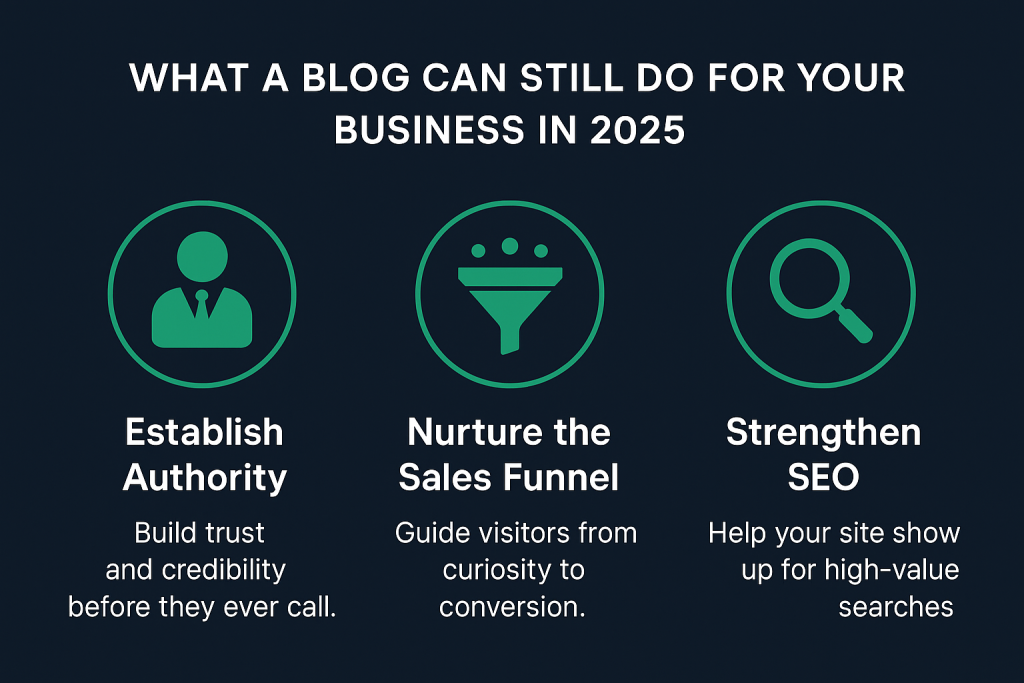
What a Blog Can Still Do for Your Business (Yes, Even in 2025)
1. Establish Authority in Your Industry
Whether you’re a law firm, a construction company, a wellness brand, or a B2B manufacturer, your customers want to know one thing: can they trust you?
A blog gives you a chance to answer that question before they ever pick up the phone.
By writing clearly and helpfully about the real issues your clients or customers face — and how you solve them — you build trust. That trust is currency. It’s the first step toward a sale, a signed contract, or a referral.
2. Fuel Your Sales Funnel Without the Hard Sell
Not everyone who visits your site is ready to buy. Some are just researching. Some are trying to understand a problem. Some are comparing vendors or providers.
Well-written blog content meets people where they are. It gives them answers. It educates without selling. And it gently moves them one step closer to choosing you — all without a sales pitch.
A blog post like “What to Expect When You’re Remodeling Your Kitchen” or “The Hidden Costs of Choosing the Wrong Insurance Broker” can do more to generate leads than any popup ever will.
3. Support Your SEO Strategy (But Only If You Know What You’re Doing)
Let’s be clear: a blog isn’t an SEO strategy. It’s a tool in your strategy.
Used properly, blog posts help your site show up for niche searches. They give you places to build internal links. They demonstrate topical depth and relevance to search engines.
But you can’t just write for “Google.” You have to write for the person who’s typing the query. If your blog answers their question better than anyone else, Google still rewards that. Even in 2025.
When a Blog is Just Digital Dead Weight
1. If You’re Not Going to Maintain It, Don’t Bother
Nothing tanks credibility faster than a blog with three posts from two years ago. If you don’t have the time or intention to update it regularly, take it offline or at least hide it from your main menu.
An outdated blog doesn’t look quaint. It looks abandoned.
2. If It’s Not Tied to Your Business Goals, It’s a Waste
Every blog post should do something specific:
- Attract people searching for your service or product
- Help visitors understand what sets you apart
- Educate your audience so they trust your expertise
- Support your sales process
- Reduce time spent answering the same questions
If it’s not doing one of those things, it’s not helping.
3. If You’re Just Posting Because Someone Told You To, It’ll Show
Posting content for the sake of “being consistent” without any direction or intent is worse than not posting at all. No one needs another “5 Tips for Spring Cleaning” article from a random HVAC company. Make it specific. Make it useful. Make it yours.
What to Write About (and What to Avoid)
If you’re serious about blogging, focus on topics your audience actually cares about. Think about the questions your team hears every week. Think about the reasons people hesitate to buy. Think about the problems you solve better than anyone else.
Good blog content in 2025 includes:
- ✅ How-to guides that walk people through confusing processes
- ✅ Posts that explain your services in plain language
- ✅ Stories that show how you’ve helped past customers
- ✅ Industry-specific breakdowns or thought leadership
- ✅ Articles that solve a real-world problem your clients face
Avoid content like:
- ❌ Generic listicles with no point of view
- ❌ Company news no one outside your office cares about
- ❌ SEO-fluff posts with no substance
- ❌ Anything that reads like it was written by AI with no editing
You don’t need to post daily. But you do need to post with purpose.
Final Verdict: Should Your Website Have a Blog?
If you sell something complex, compete in a crowded market, or rely on trust to win customers — then yes, a blog can be one of your most valuable assets.
But it has to be intentional. It has to be real. And it has to align with your goals.
If you’re not ready to commit to that? Skip it. Put your energy into building better landing pages, tightening your copy, or improving your site speed. Any of those will get you further than a half-baked blog ever will.
TL;DR (But Let’s Be Honest, You Should’ve Read It)
- Blogging in 2025 isn’t dead, but it is different
- A blog only helps if it supports your actual business goals
- Quality > quantity, every single time
- If you’re not going to maintain it, don’t start it
- Done right, a blog builds trust, drives traffic, and supports sales
Need Help?
Want help planning a smart blog strategy that actually fits your business? Or need to clean up years of old content that’s dragging your site down? Reach out. We do this every day.